

Google Ads or Meta Ads—which one should you actually run for your business? If that is the question that has brought you here, then you are in the right place, because most businesses ask this question before they ask anything else.
Here is the short version: Google Ads puts you in front of people who are already searching for what you sell, and Meta Ads puts you in front of people who are not searching yet but will stop scrolling for the right offer. Neither Google Ads nor Meta Ads is better by default. It depends on your product, your budget, and what you are trying to achieve.
If you get the choice wrong, then your ad spend disappears on clicks that will never convert and iif you run both with a clear strategy, you will see results show up in leads, sales, and brand visibility fairly quickly.
In this blog, you will learn how Google Ads and Meta Ads actually work, which platform fits which type of business, how to choose between Google Ads and Meta Ads based on your specific goals, and a straight-up cost comparison between the two.
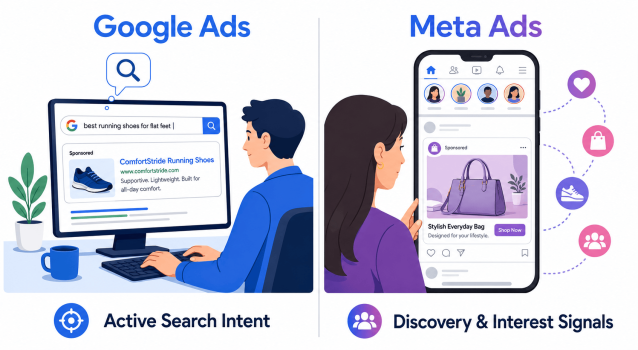
Google Ads primarily captures existing search intent, while Meta Ads helps audiences discover products through interests, behaviour and other audience signals.
The Key Difference Between Google Ads and Meta Ads
This is one of the most important things you should understand before comparing anything else.
Google Ads shows ads to those people who are actively searching for something. For example: When someone types “best digital marketing agency in Delhi” on Google, your ad can appear right at the top. This is what we call intent-based advertising. The person is already looking for a solution, and your ad is simply showing up at the right moment.
Meta Ads targets people based on who they are and not what they are looking for. Meta owns Facebook and Instagram and uses detailed data about users including age, location, interests, and online behaviour. It shows ads to people who are most likely to be interested in your product and services.
In simple terms, Google Ads targets people when they are ready to act, whereas Meta Ads reaches people before they even think about your product.
Google Ads vs Meta Ads for Lead Generation
When it comes to Google Ads vs Meta Ads for lead generation, the answer will largely depend on your industry and how urgently your customers look for solutions.
Google Ads works better for lead generation:
- When customers are actively searching before buying or inquiring.
- Your service solves an urgent problem such as plumbing, legal advice or medical care
- Your business operates in a high-intent industry like real estate, education or financial services.
- You want leads from people who are ready to take action right now.
Meta Ads works better for lead generation when:
- Your product or service needs awareness before people are considering it.
- You want to capture leads from a specific demographic audience.
- You use lead generation forms directly within Facebook or Instagram.
- Your product appeals to a lifestyle or interest group that Meta can target precisely.
Google Ads vs Meta Ads for E-Commerce
For e-commerce, Google Shopping Ads show your product image, price, and brand name directly in search results. This drives highly relevant traffic from people who are ready to purchase.
Meta Ads excel at product discovery on Instagram and Facebook. A visually attractive ad can create desire in someone who was not looking for your product at all. Meta retargeting ads, which show products to people who have already visited your website and who did not complete a purchase. It is among the most effective tools in e-commerce and advertising strategies.
The smartest way for e-commerce strategy is to combine both. Use Google Shopping Ads to capture active buyers and use Meta Ads to build awareness and retarget warm audiences who visited your website but did not complete a purchase.
Google Ads vs Meta Ads Cost: What Should You Expect to Spend?
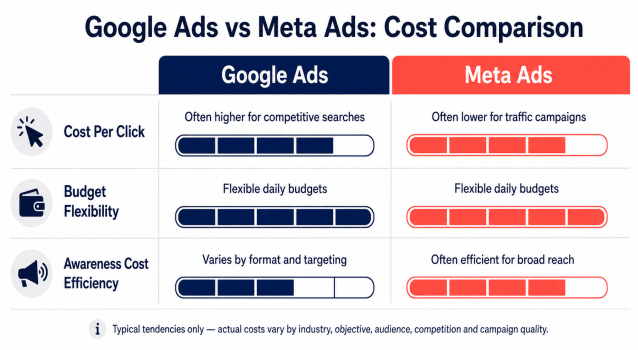
Meta Ads have a lower cost per click than Google Ads. Competitive industries on Google, such as finance, legal, or real estate, can cost significantly more per click.
| FACTORS | GOOGLE ADS | META ADS |
| Cost Per Click (CPC) | Generally higher CPC | Generally lower CPC |
| What Affects Cost | Keyword competition and search volume | Audience size, creative quality, and campaign objective |
| Budget Flexibility | Start small and scale as results improve | Flexible budgets with a low entry point |
| Best For Awareness | Less cost-efficient for broad awareness campaigns | Very low cost per impression for brand awareness campaigns |
| Intent Level | Users are actively searching—a stronger conversion signal | Users are browsing—wider reach at lower cost |
| ROI Consideration | Higher cost per click balanced by higher conversion rates | Lower cost per click, but conversion rates may vary by audience |
In terms of Google Ads vs Meta Ads cost, Meta Ads are typically cheaper per click. But cheaper clicks do not always mean better results.
Google Ads vs Meta Ads Conversion Rate: Which Converts Better?
Conversion rate is where you will see the real difference between these two platforms.
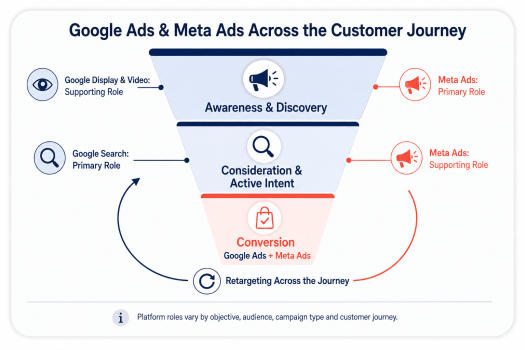
Google Ads generally delivers higher conversion rates for direct response campaigns because the person clicking on the ad is already searching for what you offer, so the intent is strong. The gap between clicking the ad and making a decision is shorter.
And when we talk about Meta Ads, it has lower direct conversion rates for cold audiences. However, they perform very strongly for retargeting campaigns. It is where you show ads specifically to those people who have already visited your product page or added items to their cart but did not complete the purchase. Meta Ads can achieve impressive conversion rates at low cost.
The key takeaway here is that Google Ads vs. Meta Ads conversion rate comparisons only make sense when you compare campaigns with similar objectives. A Google search campaign should not be compared to a Meta awareness campaign. They should serve different purposes in the marketing funnel.
Which Gives Better ROI: Google Ads or Meta Ads?
Google Ads tends to deliver better ROI for:
- Service businesses where customers are searching before buying.
- Local businesses that are targeting people with urgent needs.
- High-intent purchases like healthcare, education or real estate.
Meta Ads tends to deliver better ROI for:
- E-commerce brands with visually appealing products.
- Lifestyle, fashion and consumer brands.
- Retargeting campaigns aimed at warm website visitors.
For most businesses, the highest ROI comes when both of the platforms are used strategically.
How DI Infotech Helps You Get the Best Results
Choosing between Google Ads and Meta Ads requires a clear understanding of your audience, goals and budget, and this is where professional expertise makes the difference between good results and wasted spend.
DI Infotech is a trusted performance marketing agency in Delhi with deep expertise in both Google Ads and Meta Ads. Our team helps businesses across India identify the right platform mix, build high-performing campaigns, and continuously optimize for better results.
Whether you need Google Ads management, social media advertising, or a fully integrated performance marketing strategy, we build data-driven campaigns that will be tailored to your specific business goals.
Explore our full range of performance marketing services here: DI Infotech Performance Marketing Agency
How to Choose Between Google Ads and Meta Ads: A Simple Decision Framework
Use this simple guide to make your decision:
Choose Google Ads: Google Ads is considered to be a suitable choice when customers are already searching before buying. It works well for service businesses where customers need it immediately, and it helps you generate leads from users who are already interested and ready to act.
Choose Meta Ads: Meta Ads works well if your products or services benefit from visual storytelling. It helps you build brand awareness among specific audiences and works well for lifestyle, fashion, food, or consumer products.
Choose both: Using Google Ads and Meta Ads together can help businesses cover the complete customer journey. fromomer, from building awareness to driving conversions. This works well for businesses that have the budget to test, optimize and scale campaigns across multiple platforms.
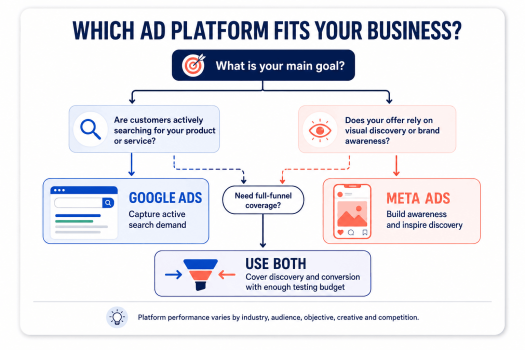
Choose Google Ads to capture active searches, Meta Ads to build discovery and awareness, or combine both for full-funnel coverage when sufficient testing budget is available.
You should always start with clear goals and define what success looks like before you choose a platform. Whether you are trying to get ten new leads per month or sell 500 products or build awareness in a new city. Your goal should always determine your platform choice, not the other way around.
A Real-World Example: How Businesses Use Both Platforms Together
Consider a Delhi-based online clothing brand. They use Meta Ads on Instagram to showcase their new collections to fashion-conscious women between 22 and 35 in major Indian cities. This builds awareness and drives traffic to their website.
Next, they use Google Shopping Ads to capture people who are actively searching for specific types of clothing they stock. These ads convert at a higher rate because the intent is already there.
Finally, they run Meta retargeting ads targeting people who visited their website but did not purchase. These ads show the exact products those users viewed, with a limited-time discount offer. This brings back a strong percentage of lost visitors and drives sales at a very low cost per conversion.
This combined approach delivers far better overall ROI than either platform could achieve alone.
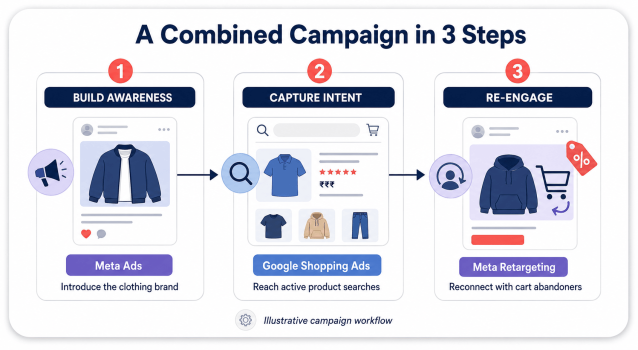
This illustrative workflow uses Meta Ads to build awareness, Google Shopping Ads to capture active searches and Meta retargeting to reconnect with cart abandoners.
Conclusion
Both platforms are powerful and can deliver strong ROI. But they work differently and suit different business goals. Google Ads works well for reaching customers who are actively searching for a product or service, while Meta Ads helps businesses connect with audiences based on their interests and online behavior. When you use both platforms together with regular performance tracking, it can help you create a more effective advertising strategy.
If you don’t know where to start or how to get the most from your advertising budget, working with a professional performance marketing agency is the fastest way to get it right. Visit DI Infotech today and let our expert team build a strategy that delivers real, measurable results for your business.
Frequently Asked Questions (FAQs)
Which is better for small businesses: Google Ads or Meta Ads?
The right platform will always depend on your industry and goals. Service businesses often benefit from Google Ads, while product-based brands may perform well on Meta Ads. Testing both helps identify the best fit.
What is the minimum budget to start Google Ads or Meta Ads in India?
There is no fixed minimum for either platform. For Google Ads, it starts with at least Rs. 5,000 to Rs. 15,000 per month for meaningful results. For Meta Ads the budget should be Rs. 300 per day or more for the algorithm to optimize properly. Most small businesses in India spend Rs. 10,000 to Rs. 30,000 per month per platform.
How long does it take to see results from Google Ads vs Meta Ads?
Google Ads can start delivering results quickly for high-intent searches, while Meta Ads usually need more time to gather data and optimize performance. Both platforms improve as more campaign data becomes available.
Should I run Google Ads and Meta Ads at the same time?
Yes, businesses with the right budget can benefit from running both platforms together. Google Ads captures users actively searching, while Meta Ads helps build awareness and reconnect with potential customers. And when they are combined together, they support different stages of the customer journey.
Which platform is better for e-commerce businesses in India: Google Ads or Meta Ads?
Both of the platforms work well but serve different purposes. Google Ads captures buyers actively searching for your product, while Meta Ads work better for product discovery and retargeting visitors who did not buy. Most successful e-commerce businesses in India use both platforms together for the best results.
Also read
What Is Performance Marketing? A Complete Guide for Businesses
How to Calculate ROAS: Formula, Examples & 7 Ways to Improve It in 2026
Why Your Paid Ads Aren’t Converting: 10 Problems That Waste Ad Budget
0 Comments