

Want to know how to calculate ROAS? It is simple: divide the revenue your ads generate by the amount you spent on those ads, then multiply by 100 to get a percentage. That is the short answer. But there is more to know if you want your ads to actually make money for your business.
Return on Ad Spend: ROAS tells you if your advertising is working or not. It shows how many rupees you earn for every rupee you spend on ads. If you run ads on Google, Facebook, or Instagram, then you need to track this number.
In this blog, you will learn the ROAS formula, see real examples, and discover 7 easy ways to improve your ROAS in 2026. Let’s get started.
What Is ROAS, and Why Does It Matter for Your Business?
ROAS basically stands for Return on Ad Spend. It measures how much money you get back from every rupee spent on advertising.
You can even think of it like planting seeds; you spend money on ads (the seeds), and those ads bring in sales (the harvest). It tells you how big your harvest is as compared to how many seeds you planted.
When we talk about a good ROAS, it means your ads are profitable, and a poor ROAS means you are losing money or barely breaking even.
Why ROAS Matters for Your Business
Most business owners want to know whether or not their marketing budget is being used well, and ROAS gives you a clear answer. There are reasons why it matters:
- It gives you a clear picture of which ads are working and which are not.
- It also helps you decide where to spend more money.
- It builds trust with clients and stakeholders who want proof of results.
- It helps you make smarter budget decisions for future campaigns.
Why Marketers Track Return on Ad Spend
When you track return on ad spend, it helps you make smarter decisions about where to put your budget, and when you don’t track it, then you are basically guessing. With proper tracking of ROAS, every budget decision becomes data-driven and defensible. For example, if one of your campaigns is giving you an ROAS of 8 and another is giving you an ROAS of 2, then you will know immediately where to invest more.
The ROAS Formula: How to Calculate Return on Ad Spend
Now let’s deep dive into the actual ROAS formula. This is the return on ad spend formula, which is used by marketers worldwide:
ROAS = Revenue from Ads ÷ Cost of Ads
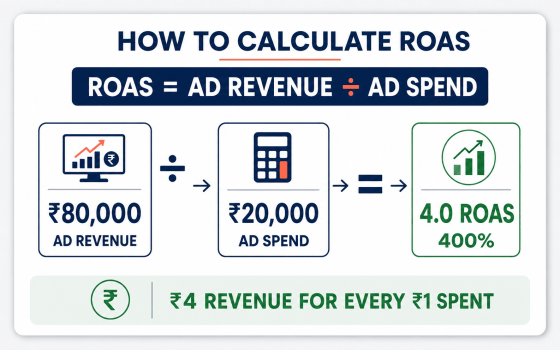
Rs 80,000 ÷ Rs 20,000 produces a 4.0 ROAS, meaning Rs 4 in revenue for every Rs 1 spent.
You can also express this as a percentage by multiplying the result by 100. Here is what total revenue from ads and total ad spend mean:
Total Revenue from Ads: The total sales or income generated directly from your ad campaigns
Total Ad Spend: The total amount you paid to run those ads, including platform costs
ROAS Calculation Example With Real Numbers
Let us make this practical with a real ROAS calculation example using Indian rupees.
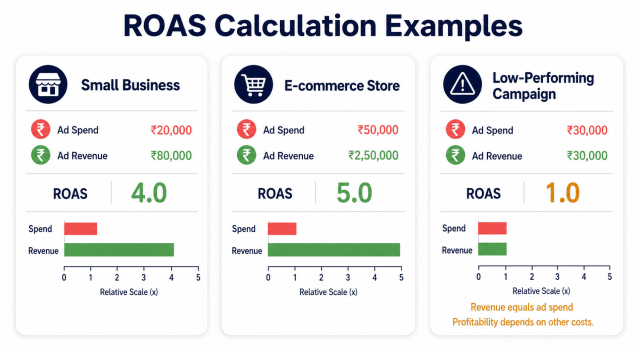
Small Business
If a small business spent Rs 20,000 on ads and generated Rs 80,000 as revenue, and if you divided 80,000 by 20,000, you would get an ROAS of 4, which means for every 1 rupee you spent on advertising, your business earned 4 rupees back.
E-Commerce Store
If an e-commerce store invested Rs 50,000 on ads and earned Rs 250,000 as revenue, and if you divided 250,000 by 50,000, it gives you an ROAS of 5. This means every 1 rupee spent on the store earned 5 rupees.
Low-Performing Campaign
If a business spent Rs 30,000 on ads and earned exactly Rs 30,000 as revenue, and if you divided both the numbers together, then you get an ROAS of 1. It means your business neither lost money nor gained any profit. This type of campaign will need immediate optimization and attention.
How to Calculate ROAS for Google Ads and Meta Ads
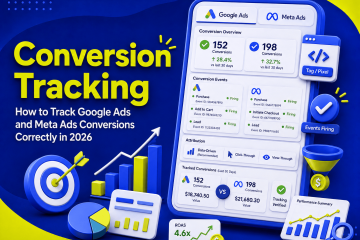
Both Google Ads and Meta Ads have built-in ROAS tracking inside their dashboards, but you still need to set up conversion tracking correctly because without proper tracking, all the numbers will be inaccurate and not reliable.
For Meta Ads, you should install the Meta Pixel on your website, and for Google Ads, you should set up Google Tag Manager and link your conversion goals. Once these are set up and active, both platforms will automatically start calculating and displaying ROAS inside your campaigns reports.
How to Set a ROAS Target Before You Launch Your Campaign
Most businesses launch ad campaigns and then check ROAS afterwards, which is considered to be the wrong approach. If you set your ROAS target before spending a single rupee, it gives you a clear goal and prevents wasted budget from day one. Here is how to do it in three simple steps.
Step 1: Calculate Your Break-Even ROAS
Break-Even ROAS = 1 divided by your gross profit margin.
For example, if your profit margin is 50 percent, your break-even ROAS is 2. This means you need to earn Rs 2 for every Rs 1 spent just to cover costs. Anything below this and your ads are losing you money.
Step 2: Set Your Profitable ROAS Target
Break-even is not your goal. Add your desired profit margin on top. If your break-even is 2 and you want a healthy profit, aim for a ROAS of 3 or above before launching.
Step 3: Match Your Target to Your Campaign Type
Not every campaign should chase the same ROAS target. Different campaign goals require different expectations.
Retargeting campaigns: Aim for a higher ROAS of 4 to 6 or more because these audiences already know your brand and convert more easily.
New audience campaigns: Accept a lower ROAS of 2 to 3 initially because you are building awareness and collecting data and not just chasing immediate sales.
Brand awareness campaigns: Do not measure these by ROAS at all. Use reach, impressions, and engagement metrics instead.
Setting the right target for the right campaign type stops you from making the mistake of cutting a healthy awareness campaign simply because its ROAS looks low compared to your retargeting campaigns.
7 Ways to Improve Your ROAS in 2026
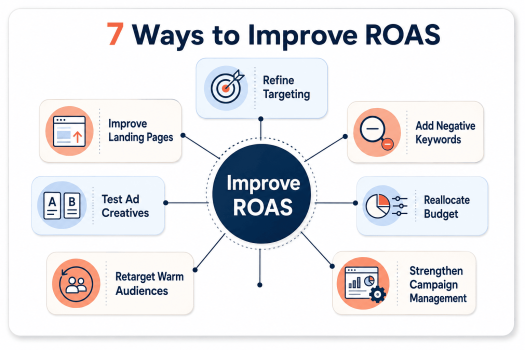
Improving ROAS requires coordinated optimization across targeting, advertising, landing pages, budget allocation and campaign management.
1. Tighten Your Audience Targeting
When you use broad targeting, it wastes your budget on people who will never buy from you. You should narrow your audience targeting using location, age, interests and purchase behavior because the more specific your audience is, the higher your conversion rate and the better your return on ad spend.
2. Improve Your Landing Page Experience
If your landing page is slow, confusing, and not mobile-friendly, then visitors leave without buying, which means getting clicks is only half the job. Then you must improve your landing page experience. A strong landing page that matches your ad message directly improves conversion and increases ROAS without increasing your spend.
3. Use Negative Keywords to Reduce Wasted Spend
In Google Ads, use negative keywords to stop your ads from showing to irrelevant people and searches. For example: If you have a business that sells premium furniture, add “cheap” or “free” as negative keywords; it will simply cut wasted clicks and improve overall ROAS.
4. Test and Optimize Your Ad Creatives
A stronger ad creative gets more clicks from the right people. You should test different headlines, images, videos, and calls to action regularly because even a small improvement in click-through rate from better creatives can meaningfully improve your ROAS formula output.
5. Focus Budget on High-Converting Campaigns
You should identify your top-performing campaign by using your ROAS data and shift more budget towards because not all campaigns perform equally. You must reduce or pause campaigns that have a low return on ad spend and let the data guide your budget decisions.
6. Use Retargeting to Re-Engage Warm Audiences
Retargeting shows ads to people who already visited your website or engaged with your brand. These audiences convert at much higher rates than cold audiences. Retargeting campaigns consistently deliver some of the highest ROAS numbers across both Google Ads and Meta Ads.
7. Work With a Performance Marketing Expert
Managing ads, tracking ROAS, and optimizing campaigns simultaneously is a full-time job. Many businesses improve their return on ad spend dramatically simply by working with the right experts.
DI Infotech is a trusted performance marketing agency in Delhi that specializes in building data-driven campaigns across Google Ads, Meta Ads, and other paid platforms. Our team tracks every rupee spent, monitors ROAS continuously, and makes real-time adjustments to keep your campaigns profitable and growing.
Whether you are struggling with a low ROAS or want to scale campaigns that are already working, we have the expertise to help you get there faster.
Explore our performance marketing services here: DI Infotech Performance Marketing Agency
Common ROAS Calculation Mistakes to Avoid
Many businesses track ROAS incorrectly and make bad decisions as a result. Here are the most common mistakes you should avoid:
- Not setting up conversion tracking properly
If your tracking is broken, your ROAS numbers are meaningless.
- Including organic revenue in ad revenue
Only count revenue that came directly from your ads.
- Ignoring profit margins
A ROAS of 4 sounds great but may still be unprofitable if your margins are thin.
- Comparing ROAS across very different campaigns
A brand awareness campaign will always show lower ROAS than a retargeting campaign. Compare like with like.
- Obsessing over ROAS at the expense of scale
Sometimes accepting a slightly lower ROAS allows you to reach more customers and grow overall revenue faster.
Conclusion
Understanding how to calculate ROAS is one of the most valuable skills any business owner or marketer can develop. The ROAS formula is simple: divide your revenue from ads by your ad spend. But using that number to make smarter decisions is where the real value lies.
A good return on ad spend means your advertising budget is working hard for your business. A poor ROAS is not a failure. It is a signal that something needs to change, whether that is your targeting, your creatives, your landing page, or your overall strategy.
Use the seven improvement strategies in this blog to start lifting your ROAS today. And if you want expert help building campaigns that deliver consistent, measurable results, visit DI Infotech and speak to our performance marketing team.
Frequently Asked Questions (FAQs)
Is a higher ROAS always better?
Not always. A high ROAS may indicate strong efficiency, but it can also result from limited ad spend or a narrow audience. Evaluate ROAS alongside revenue growth, reach, and overall profitability.
How often should I check my ROAS?
Check ROAS weekly for active campaigns to track ad performance. For new campaigns, allow enough time and data to accumulate before making major optimization decisions.
What is the difference between ROAS and ROI?
ROAS measures revenue earned from ad spend, while ROI measures overall profit after all business costs. Use ROAS to evaluate ad campaign performance and ROI to measure overall profitability.
How can I improve a low ROAS?
Improve a low ROAS by refining audience targeting, testing stronger ad creatives, optimizing landing pages, and reducing wasted ad spend. Shift more budget to high-performing campaigns and use retargeting to reach interested users.
How does conversion tracking affect ROAS?
Conversion tracking directly affects ROAS accuracy by showing which ads generate sales or leads. Proper tracking helps you measure true ad performance, calculate ROAS correctly, and make better budget decisions.
Also read:
What Is Performance Marketing? A Complete Guide for Businesses
Why Your Paid Ads Aren’t Converting: 10 Problems That Waste Ad Budget
0 Comments