

Most businesses running ads are doing it without a real strategy behind them. They pick a platform, set a budget, and wait. Sometimes it works, and at times it does not, and they never know what the reason is behind it.
A performance marketing strategy fixes that. At its core it comes down to five things: clear goals, the right channels, a budget that makes sense, consistent tracking, and regular optimization based on what the data is actually telling you. It is not complicated in theory but harder to execute than most people expect.
This blog will walk you through how to build one strategy properly, from choosing the right channels and structuring your campaigns to planning your budget and measuring results that go beyond metrics. Whether you are running a business or managing marketing, the steps here are practical, specific, and built for 2026, not three years ago.
Performance Marketing Strategy: A Step-by-Step Guide
What Is a Performance Marketing Strategy?
Think of a performance marketing strategy as a plan where every moving part has a job. Every campaign, every channel, and every rupee spent connects directly to a business goal.
That is what separates it from traditional brand advertising. In brand advertising you pay for exposure and take your chances, and in performance marketing you decide what success looks like before a single ad goes live, you build campaigns around that target, and then track everything closely enough to know what is working and what is actually not working and draining your budget. Here the data makes the decisions.
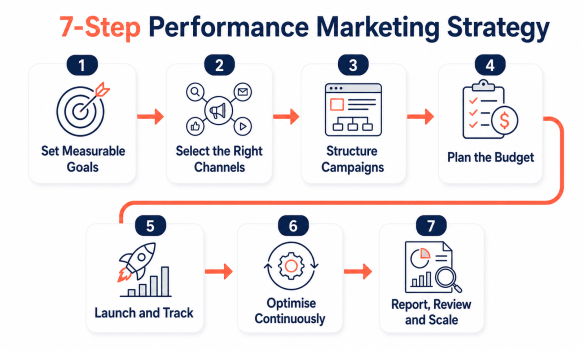
Step 1: Set Clear and Measurable Goals
Every strong performance marketing plan starts with clear goals because without a defined goal, you cannot measure success or failure. For example, generating 200 qualified leads per month at a cost per lead below Rs. 500 is a strong goal and not just getting more leads.
Step 2: Identify the Right Performance Marketing Channels
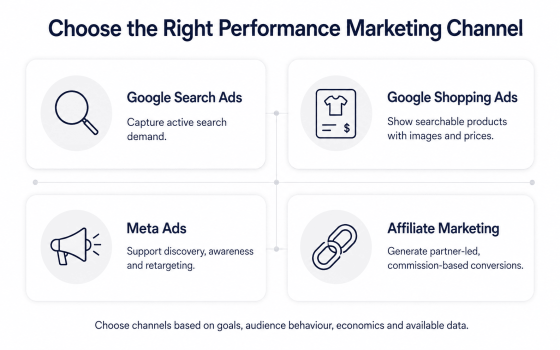
One of the most important decisions in your strategy should be choosing the right performance marketing channels because not every channel works for every business.
Choosing the right performance marketing channels is one of the most important decisions in your strategy. Not every channel works for every business.
Here are the main performance marketing channels and when to use them:
Google Search Ads are best for businesses where customers actively search before buying.
Google Shopping Ads are best for e-commerce stores that want to show their products directly in search results with images and prices.
Meta Ads (Facebook and Instagram) are best for product discovery, brand awareness, and retargeting, often working hand-in-hand with organic social media marketing efforts.
Affiliate marketing is best for businesses that want to pay only when a sale is completed. Partners promote your product and earn a commission per conversion.
If you are unsure which platform fits your business, our detailed comparison on Google Ads vs Meta Ads can help you decide where to start.
Step 3: Build Your Performance Marketing Campaign Structure
A well-structured performance marketing campaign makes tracking and optimization significantly easier. Here is a simple performance marketing framework to follow:
Campaign-level helps you set the overall goal and budget. For example, one campaign for lead generation and a separate campaign for retargeting.
Ad Group or Ad Set Level helps you organize by audience segment or product category. For example, one ad set targets cold audiences, and another targets website visitors.
Ad Level creates multiple ad variations to test different headlines, images, and calls to action. When you test at this level, it tells you exactly what your audience responds to.
These levels help you to organize your campaigns and make clear reporting, and they also allow you to identify what is working at every stage.
Step 4: Plan Your Performance Marketing Budget
When it comes to performance marketing budget, it should be allocated based on expected return and not just spend that is available.
Start with your target cost per acquisition. If you know you can profitably acquire a customer at Rs. 1,000, work backwards to determine how much total budget you need to hit your monthly lead or sales target.
Allocate budget by channel performance. Give more budget to channels that consistently deliver results. Reduce or pause spending on channels that underperform after a fair testing period.
Keep a testing budget separate. Reserve 10 to 20 percent of your total budget for testing new audiences, creatives, and channels. This prevents your main campaigns from being disrupted while you experiment.
Review and adjust monthly. A performance marketing budget is not fixed. It should shift based on real data every month.
Step 5: Launch and Track With a Data-Driven Marketing Strategy
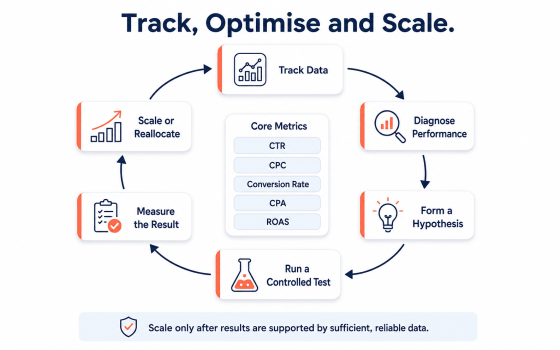
When you talk about data-driven marketing strategy, it means every decision you make should be backed by real numbers and not just assumptions, and once your campaign is live, you should track these key metrics consistently:
- CTR (Click-Through Rate): Are enough people clicking your ads?
- CPC (Cost Per Click): Are you paying a competitive rate for traffic?
- Conversion Rate: Are visitors taking the action you want?
- CPA (Cost Per Acquisition): How much does each lead or sale cost?
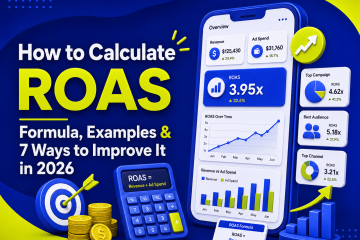
- ROAS (Return on Ad Spend): How much revenue does each rupee of ad spend generate?
Want to know exactly how to calculate it? Read our full guide on how to calculate ROAS.
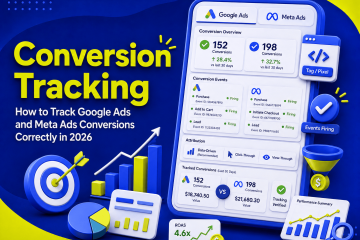
Set up proper tracking before launching. Use Google Tag Manager for Google campaigns and Meta Pixel for Facebook and Instagram because without accurate tracking, your data is unreliable, and your decisions will be based on incomplete information.
Step 6: Optimize Continuously
Launching campaigns is only the beginning. The real work in performance marketing happens after you launch an ad. You should optimize at every level:
- Audience level: You should pause underperforming audience segments and focus on those that convert.
- Creative level: Always replace ads that are low-performing and add new variations every three to four weeks.
- Landing page level: You should test different headlines, layouts, and calls to action to improve conversion rates.
- Bid level: Always adjust bids based on device, location, time of day, and audience behavior
Because small and consistent improvement always leads to compounding overtime.
Step 7: Report, Review, and Scale
The final step in any performance marketing framework, which includes regular reporting and reviewing of data Because monthly reporting keeps you accountable to your goals and it also helps you to identify opportunities to scale.
Strong performance marketing should cover your total spend vs. total revenue generated, cost per lead or cost per acquisition trends, performance by channels and campaigns, key wins and areas that require improvements, and ROAS across all active campaigns.
Use these reports to improve and scale your decisions. When your campaign always hits its targets, then you should increase the budget gradually, and if it does not perform well after optimizations, you should pause it and redirect the budget to those campaigns that perform well.
How DI Infotech Builds Performance Marketing Strategies That Deliver Results
Building and managing a performance marketing strategy across multiple channels is a full-time job. It requires expertise in campaign structure, audience targeting, creative testing, bid management, and data analysis.
DI Infotech is a trusted performance marketing agency in Delhi that specializes in building complete, data-driven performance marketing strategies for businesses across India. Our team manages campaigns across Google Ads, Meta Ads, and other paid channels with a single focus: delivering measurable results for every client.
From defining your goals and selecting the right performance marketing channels to structuring campaigns, managing budgets, and optimizing continuously, we handle every step of the process with transparency and accountability.
Whether you are building your first performance marketing plan or looking to scale campaigns that are already running, DI Infotech has the experience and the tools to take your results to the next level.
Explore our full performance marketing services here: DI Infotech Performance Marketing Agency
Conclusion
A strong performance marketing strategy is not only built on clear goals but also the right channel mix, a well-defined campaign framework, a flexible budget, and continuous optimization.
When we think of performance marketing, it is not a one-time activity but an ongoing process of testing, learning, and scaling. Businesses that are committed to this process consistently tend to outperform those who rely on guesswork and fixed budgets.
So if you are ready to build a performance marketing strategy that actually delivers results, visit DI Infotech today. Our expert team will help you plan, launch, and grow campaigns that make every rupee of your advertising budget count.
Frequently Asked Questions (FAQs)
What is the first step in building a performance marketing strategy?
Set a clear and measurable goal, because without one clear goal there is nothing to measure success against.
How much should I budget for performance marketing?
There is no magic number here. You should start small and watch your results closely, and only scale up what you spend on what is actually working.
Which channel works best in performance marketing strategy?
It entirely depends on your business. When it comes to Google Ads, it suits people who are actively searching for something, whereas Meta Ads works well for visuals and brand storytelling.
How often should I check on my campaigns?
The ideal time to check your campaign is weekly because waiting a month means you might have already wasted your budget on something that was not working.
What does “data-driven” actually mean in performance marketing strategy?
It means you are making decisions based on real numbers like clicks, conversions, and cost per result—instead of just going with your gut feeling.
Also read:
What Is Performance Marketing? A Complete Guide for Businesses
Why Your Paid Ads Aren’t Converting: 10 Problems That Waste Ad Budget
0 Comments