
So, how long does SEO take? The earlier results that most websites will see are in 3 to 6 months, including increased impressions and first page rankings for low-competition keywords. Typically, it takes 6 to 12 months for enquiries to grow steadily. This will vary based on your website’s age, competition, and consistency of content and problem-solving.
No good agency can guarantee a date for ranking. Google determines who’s in the results, and they update them frequently. What we can do is illustrate what typically occurs month by month. If you know what to expect, what to check, and when to ask questions.
This is a walkthrough of the first 12 months of SEO. It also addresses what slows things down, how to distinguish between a normal delay and a real problem, and how to get things done quicker without taking any shortcuts.
The First 12 Months of SEO, Month by Month
Every website is different, so treat this as a guide. Each phase below shows what the team does, what you may see, and one warning sign to watch for.
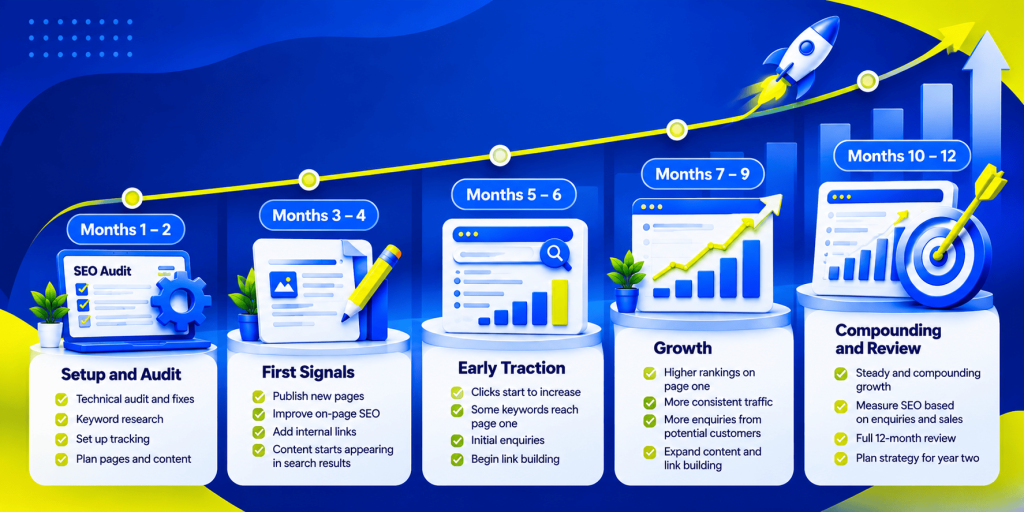
Months 1 to 2: Setup and Audit
The first two months are foundation months. There is no flash; that is normal.
What the team does: The team sets up tracking in Google Search Console and Google Analytics. It checks your site for crawl, speed, and mobile issues. It searches for keywords and correlates each keyword to a page on your site. It also fixes the biggest technical issues, such as pages that Google cannot reach.
Expect: Little to no change in traffic. More of your pages might be indexed in Search Console.
Warning sign: After two months, you have no audit report, no keyword plan, and no tracking. Ask your team to show you each one.
Months 3 to 4: First Signals
This is where the content begins to appear in your data.
What the team does: New pages and blog posts are published. Titles, headings, and content are improved on older pages. The team also adds internal links for Google to discover and comprehend the new pages.
What you can expect to see: Impressions begin to go up. Long-tail keywords that are longer and more specific might get to page two. Clicks are still low.
Warning sign: Your new pages have not been indexed after a few weeks. This is a technical or quality issue and should be addressed early.
Months 5 to 6: Early Traction
The work of the first four months should have had time to build up.
What the team is doing: The team continues to create helpful content and enhance the pages that are already on page two. It begins with link building, obtaining links from other reputable websites.
What you might expect to see: Clicks increase from month to month. Some keywords get to page one. This is when many sites start getting search enquiries.
Warning sign: Three consecutive months of flat impressions. Your content may not align with what searchers are looking for, so check the top ranking pages for your keywords.
Want a clear SEO plan for your own site? Our team can audit your website, set realistic goals, and show you what to expect each month. Learn more about our SEO services in Delhi.
Months 7 to 9: Growth
That’s where regular SEO efforts begin to bear fruit.
What the team does: The team creates more content on the topics that work. It refreshes pages that are on page two, and it continues to get quality links. It also incorporates new keywords into the plan.
What you might experience: Higher rankings on page one and more consistent traffic. Questions are more frequent and typically from individuals already looking for your product or service.
Warning sign: Traffic increases, but enquiries do not. Look at your rankings to see if you’re targeting the right keywords and see if your pages are easy to call or fill out a form.
Months 10 to 12: Compounding and Review
At this point, previous work continues to be beneficial. Visitors can come back to a page you published in month 4 and still return in month 11.
What the team does: The team runs a full 12-month review. Compares traffic, rankings, and enquiries to the starting point. It then creates the year two plan.
What you might see: Growth that builds upon itself. Now you can measure SEO based on enquiries and sales, not rankings.
Warning sign: No improvement in impressions, clicks, or enquiries after 1 year. Request an explanation in simple terms and a new plan, rather than a reiteration of the previous plan.
What Changes How Long SEO Takes?
Two businesses can start SEO on the same day and see very different results. These factors explain why.
- Website age and history. An older site with a clean record usually moves faster than a brand-new one. A site with past technical problems may need cleanup first.
- Competition. It is easier to rank for a local or niche phrase than it is to rank for a general phrase that the big brands are trying to rank for.
- Content and search intent. The page you create should answer the searcher’s query. Even if a page is well optimised, it will struggle if it doesn’t have this.
- Technical health. If Google cannot crawl or index your pages, nothing else works until you fix that.
- Backlinks. When the trusted website links back to you, it tells Google that others vouch for you. A site with fewer links will take longer.
- Resources and consistency. Progress is made through regular publishing and continuous fixes. Restarts when started and stopped.
Here is how the pace usually differs by type of site.
| Type of site | Typical pace |
| New website with no history | Slowest start. Plan for 6 to 12 months before steady results. |
| Established site with some traffic | Often faster. Early gains can appear in 3 to 6 months. |
| Online store with many products | Depends on how many pages need work. See our e commerce SEO service for how this works. |
| Site with technical problems | Fix first, then grow. Cleanup can add a few months. |
Normal Delay or Warning Sign?
SEO is slow, but it should not be silent. Use these checkpoints to see whether you are on track.
- At month 3: Your pages should be indexed, and you should have a clear keyword plan. Impressions should be starting to rise.
- At month 6: You should see more clicks and some page-one rankings. If impressions and clicks are both flat, ask why.
- At month 9: You should see steady growth in traffic, and enquiries should be starting to follow.
If you miss a checkpoint, start with the basics: indexing, search intent, and technical issues. Our guide on common reasons a website is not ranking explains how to find the cause.
Be careful with any agency that promises a #1 ranking by a set date. Nobody controls Google’s results. A good agency shares a plan, reports progress each month, and explains what it is doing. Our list of questions to ask an SEO company can help you check.
How to Get SEO Results Faster, Without Shortcuts
You cannot force Google to move faster. But you can remove things that slow you down.
- Fix indexing first. Submit your sitemap in Search Console and ensure that your key pages are not blocked.
- Target long-tail keywords. Specific phrases have less competition, so they often rank sooner.
- Update pages on page two. It’s often quicker to improve a page that’s already ranking than to create a new page.
- Link new pages from strong pages. Internal links enable Google to discover new content in a timely fashion.
- Match search intent. Look at what already ranks and make your page more useful.
- Avoid shortcuts. Bought links and thin, copied content may give a short jump, but they can hurt you later.
Paid ads can also bring visitors while SEO builds. Ads stop working when you stop paying, while SEO keeps working. Many businesses use both.
Does AI Search Change the SEO Timeline?
Many searches now feature AI answers and AI summaries. They can affect the way people click, even if you get better rankings. So, don’t judge SEO based on rankings. Observe impressions, clicks, and enquiries together.
If you want your brand to appear in AI answers too, read about our generative engine optimisation service. We do not claim a fixed timeline for AI visibility, because it varies by topic and by platform.
Why Choose DI Infotech for SEO Services in Delhi?
If you want help with the steps above, DI Infotech is a digital marketing agency in Vikaspuri, New Delhi, with more than 20 years in the industry. Here is what you can expect when you work with us:
- Experience since 2005. We have worked with startups and established businesses, so we know how SEO timelines change from one site and market to the next.
- A clear plan, not a ranking promise. We establish realistic objectives, communicate the plan, and inform you what you can expect each month, as this guide does.
- SEO that fits your site. We offer website SEO and e commerce SEO, so the work matches what your business needs.
- Simple, regular reports. You see what is working, what is not, and what we will do next, so you always know where you stand.
- Website and marketing under one roof. Our web development team can correct issues that are slowing your site down in the SEO process. Our performance marketing team can run ads while your SEO builds.
- A local team in Delhi. Easy access to those working on your site and quicker support when needed.
Want to know what a realistic timeline looks like for your website? Contact our team, and we will walk you through it.
FAQs
Can SEO work in one month?
SEO doesn’t usually deliver immediate business results in a month. Your team conducts an audit of the site, resolves issues, and creates a plan in the first month. During the first month, your team conducts an audit of the site, resolves issues, and creates a plan. You can expect to see improved indexing, but traffic and enquiries typically will take a few more months.
How long does SEO take for a new website?
It takes about 6-12 months to create a solid website. Google has to discover your pages and learn about what your site is about. By focusing on long-tail keywords and creating valuable content, you can get started earlier.
When will SEO start bringing in enquiries?
The initial search enquiries for many sites come in from months 4 to 9. It will depend on your competition, your content, and the ease of contact for visitors.
Why am I not seeing results after six months?
These are common reasons: pages that are not indexed, content that doesn’t meet search intent, technical issues, and high competition. Review these first, and then have your team discuss the plan for the next three months.
Should I stop SEO if it is not working yet?
Not right away. Early stopping means losing the progress made. See if you have missed the checkpoints above first. If you have, repair the cause. If you’re on track, allow the time for work.