

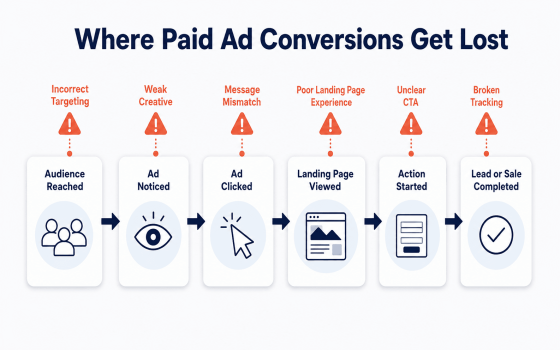
If you keep asking, “Why is my ad not converting?” the most common reasons are a mismatch between your ad and your landing page, poor audience targeting, weak ad creative, or a broken conversion tracking setup. Any of these problems can silently drain your ad budget without getting you a single lead or sale.
One of the most frustrating parts is that your ads might be getting clicks and traffic is coming in, but nothing is converting. This means awareness is not the problem; it is somewhere between the clicks and the actions you want people to take.
In this blog, you will learn 12 reasons why your paid ads are failing to convert and how to identify which problems are hurting your campaign and exactly what you can fix so you can stop wasting your ad budget.
What It Means When Paid Ads Don’t Convert
The main goal of running a paid campaign is to get clicks that turn into leads or sales but sometimes ads get so many clicks. But still they bring no results. This is one of the most frustrating and expensive problems in paid advertising.
Every click costs you money, and if that click is not leading to a result, then your ad budget is being wasted, but the good news is that most conversion problems come from a small list of common causes, and once you know what to look for, it becomes easy for you to fix.
12 Reasons Your Paid Ads Aren’t Converting
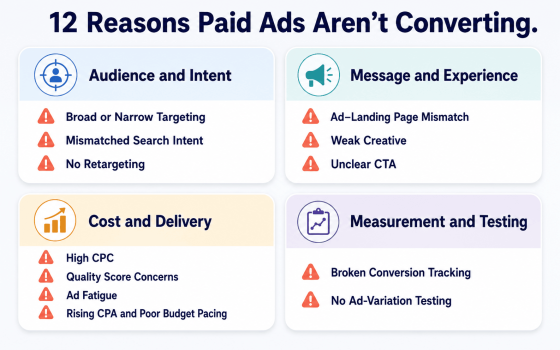
Problem 1: Your Targeting Is Too Broad or Too Narrow
If your targeting is too broad, your ad reaches people who are not interested in your product. If it is too narrow, you limit your reach and pay more for fewer results.
For example, if an ad is targeting “everyone in India,” it will likely waste money on people who will never buy. A more focused audience, based on age, interest, or location, is what brings better results.
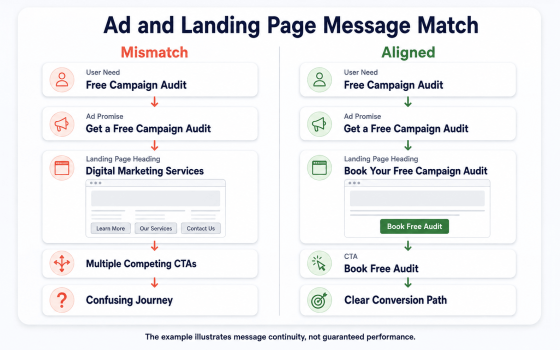
Problem 2: Your Ad and Landing Page Do Not Match
A landing page is the page people see right after they click on your ad. If this page is slow, confusing, or does not match what the ad promised, people will leave without taking any further action.
A strong landing page should always load quickly and match the ad’s message, and it should have one clear next step, like “buy now” or “get a quote.”
Problem 3: Your Ad Creative Is Not Stopping the Scroll
When you run paid ads on platforms like Facebook and Instagram, every ad you run competes with everything else in a user’s feed. If your creative does not stop someone from scrolling within two seconds, then they will never read your offer.
Weak creative is one of the fastest ways to waste your ad budget. Strong creatives for paid ads include:
- A bold, clear visual that communicates the offer instantly
- A headline that addresses a specific problem or desire
- A short, direct body copy that explains the benefit simply
- A strong call to action that tells people exactly what to do
You should always test at least three different creative variations per campaign and let the data tell you which one performs best.
Problem 4: Your Call to Action Is Unclear or Weak
Every landing page and ad needs one clear call to action because if the visitors are not really sure about what to do next, then they do nothing. Unclear call to action is one of the most overlooked causes of poor conversion rates.
Your call to action should always be like this:
- It should be specific and action-oriented. For example, your call to action should be like “Book your free consultation” and not “Submit.”
- Visible without scrolling on both desktop and mobile
- Repeated at least twice on longer landing pages
- Supported by a reason to act now, such as a limited offer or a clear benefit
Problem 5: High Cost Per Click Draining Your Budget
When your cost per click is too high, then your ad budget runs out fast; it is often before you get enough conversions to make it worthwhile.
This usually happens because of low relevance, poor targeting, or too much competition for the same keywords. Reviewing your bidding strategy regularly can help control this.
Problem 6: Low Quality Score in Google Ads
Quality score is a rating that Google gives to your ads based on relevance and expected performance. When your score is low, it raises your costs and lowers your ad position.
To improve it, you should make sure your ad copy, keywords, and landing page all match closely with each other, and when these three line up, Google rewards you with lower costs.
Problem 7: No Retargeting Strategy
Most people don’t convert on their first visit, and this is where retargeting comes in. If you are not retargeting them, then you are losing a large number of potential customers.
Retargeting shows your ads again to those people who have already visited your website but did not complete any action. This keeps your brand in front of them until they are ready to take action.
Problem 8: Mismatched Search Intent
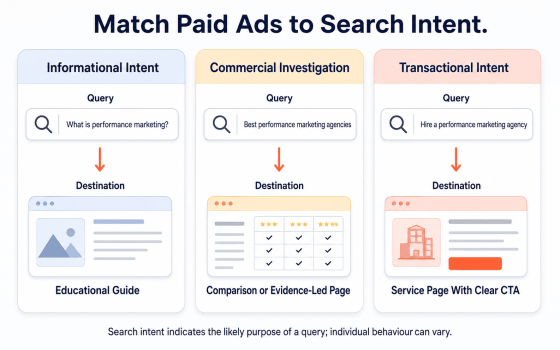
This is one of the common problems in Google Ads. It happens when you ad shows up for searches that do not match what you are offering.
For example, if someone is searching for “what is performance marketing” is looking for information, not a service. When you show a sales-focused ad to this person, it wastes your ad budget on someone who was never ready to buy.
Problem 9: Ad Fatigue on Meta Ads
Ad fatigue happens when the same audience sees your ad too many times. Over time, they stop noticing it, and your results start to drop.
Refreshing your ad creative regularly and rotating different versions helps keep engagement high.
Problem 10: No Conversion Tracking or Broken Tracking
If you are not tracking conversions correctly, you cannot tell which ads are working and which ones are wasting money. This is one of the most common and most costly mistakes in paid advertising.
Without proper tracking, decisions are based on guesses instead of real data. Setting up accurate tracking should always be one of the first steps in any paid campaign.
Getting this right starts with proper conversion tracking setup. If you are not sure where to begin, our guide on how to track Google Ads and Meta Ads conversions correctly breaks it down step by step.
Problem 11: Rising Cost Per Acquisition With No Budget Pacing
Cost per acquisition, or CPA, is what you pay to get one conversion. If your CPA keeps rising without a clear reason, it often means your budget is not being paced or reviewed properly.
Checking your campaigns weekly and adjusting bids or budgets based on performance helps keep this cost under control.
Problem 12: You Are Not Testing Different Ad Variations
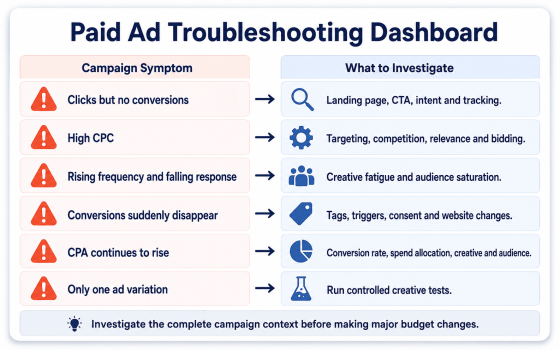
Running only one version of an ad is risky. Smart advertisers always test multiple headlines, images, and CTAs. This is called A/B testing and without it, you may be missing out on better-performing ad combinations.
Stop Wasting Your Ad Budget With Expert Help From DI Infotech
If you have identified one or more of these problems in your paid campaigns, fixing them quickly will make a significant difference to your results. But diagnosing and fixing conversion problems across multiple paid ad platforms simultaneously requires expertise and time that most business owners simply do not have.
DI Infotech is a trusted performance marketing agency in Delhi that specializes in identifying exactly why paid ads are not converting and building campaigns that fix the problem at its root. Our team audits your existing campaigns, rebuilds targeting and creative strategy where needed, sets up accurate conversion tracking, and manages ongoing optimization to ensure your ad budget generates real, measurable returns.
Whether you are running Google Ads, Meta Ads, or both, DI Infotech has the expertise to turn underperforming paid campaigns into consistent revenue generators.
Explore our performance marketing services here: DI Infotech Performance Marketing Agency
Conclusion
There could be many reasons why your paid ads are not converting; it could be a mismatched landing page, wrong targeting, broken tracking, or a weak CTA, but the good news is that each one of these problems has a simple fix.
You should start by reviewing your landing pages, checking your tracking setup, and testing new ad variations because small changes can make a big difference in your results.
And if you need expert support in order to fix your paid campaigns, then visit DI Infotech, and our performance marketing team will be ready to help. Reach out today and turn your budget into real business growth.
Frequently Asked Questions (FAQs)
Why are my ads getting clicks but no conversions?
This usually means when something is not working well after the click. It could be a weak landing page, poor tracking, or mismatched search intent.
How do I know if my ad budget is being wasted?
You should check your cost per conversion regularly, and if it keeps rising without more sales or leads, then it is likely that your ad budget is being wasted somewhere in the process.
What is a good conversion rate for paid ads?
It varies by industry, but a healthy paid advertising campaign usually sees a steady conversion rate rather than one that keeps dropping over time.
How often should I review my ad campaigns?
Reviewing your paid campaigns weekly will help you catch problems early, before they waste too much of your ad budget.
Should I pause ads that aren’t converting?
Not right away. First you should check for common issues like tracking errors or a weak landing page. If those are ruled out and results still don’t improve, pausing the ad is a reasonable next step.
Also read:
Google Ads vs Meta Ads: Which One Actually Gets You Better Results?
How to Calculate ROAS: Formula, Examples & 7 Ways to Improve It in 2026
Performance Marketing Strategy: 7 Steps for Better Results in 2026
0 Comments