

On-page SEO plays an important role in digital marketing, which helps to improve a website’s visibility on search engines like Google. It makes sure that the pages are well optimized for search engines and for users at the same time by including the best practices and techniques. If you want to know how to optimize your website’s content and structure for better search engine ranking, this beginner’s guide to on-page SEO is completely for you.
What Is On-Page SEO?
On-page SEO is optimizing the elements on your website, such as content optimization, header tags (H1/H2), meta title and description optimization, image optimization, URL structural optimization, internal and external linking, etc., by focusing on keywords to improve the ranking on the search engine results page (SERPs). The goal is to help search engines understand the content of your page so it can be shown to the right people who are searching for it.
By strategically doing on-page SEO, you tell search engines what your page is about by focusing on user intent. On-page optimization will increase the chances of your website being ranked at the top of the SERP.
Why On-Page SEO Is Important:
On-page SEO plays an important role in figuring out where your website is ranking. It is important for many reasons:
Better Understanding and Authority: Good on-page SEO helps search engines to understand what your page is about and increase the authority of your website to Google.
Better Ranking: Properly optimized websites for on-page SEO have a better chance of ranking higher in SERP and improve the site’s relevancy to user intent.
Enhance User Experience: On-page optimization is focused on enhancing the overall user experience, such as increasing the accessibility of the website and making it faster and easy to navigate, which helps in decreasing the bounce rate of the website.
How to Do On-Page SEO: Key Elements
On-page SEO includes several factors to better optimize the website. Explore the checklist below:
1. Use Relevant and Accurate Title Tags
The title tag is one of the most important on-page SEO factors. Using a relevant title tag that focuses on your primary keyword and tells search engines what your page is about has the potential to increase clicks. It is a clickable headline that appears in SERP.
A well-optimized title tag should:
- Be between 50 and 60 characters long.
- Include the main keyword near the beginning.
- Write specific titles for every page.
- Write a title tag that is relevant and accurate and that encourages the user to click.
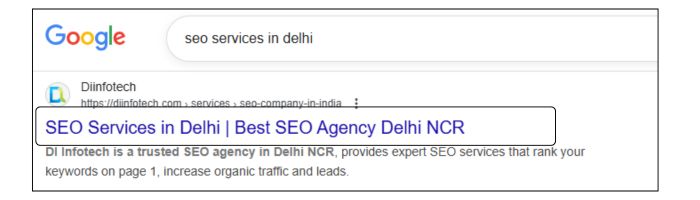
For example, if you’re targeting “SEO services in Delhi,” a good title tag could be
“SEO services in Delhi | Best SEO Agency Delhi NCR“
2. Write Descriptive Meta Description
Write a descriptive meta description that engages users and encourages them to click your page over others. The meta description is a short summary about your page content that appears below the title tag in the search engine result page (SERP). Here are examples of choosing the strong meta description that expresses the article. For example, your article is about “Top digital marketing company in Delhi.” A strong meta description for this article is “top-picked digital marketing company in Delhi. Check these top agencies in 2026 offering the best SEO, PPC, and development services.
How to write an SEO-friendly meta description
- Be between 150 and 160 characters long.
- Include relevant keywords.
- Summarize the page content clearly.
3. URL Structure—Keep It Simple and Clean
A clean URL that is easy to read and contains keywords will be ranked better, and also it is more user-friendly. Kindly avoid long and complicated URLs that contain random numbers or characters; use short and descriptive URLs that include the primary keyword.
For example:
https://diinfotech.com/services/website-development-company-in-india/
4. Headings and Subheadings—Organize Your Content
Structure your content with the heading (H1, H2, H3, etc.); it helps search engines to understand its hierarchy. H1 should be in the main title of the page, while h2 and h3 are used in subheadings. By using these steps, your content will be more readable and engaging.
Best practices for headings:
- Use H1 for the main title.
- Use H2 for major sections of the page (e.g., What Is On-Page SEO).
- Use H3 for sub-sections (e.g., Key Elements of On-Page SEO).
- Include relevant keywords like “SEO agency in Delhi” in your headings.
5. Content Optimization—Quality Over Quantity
The content should be informative, engaging, and well optimized for your target keywords. Don’t do keyword stuffing; it can hurt your rankings. Ideally aim for natural, high-quality content that adds value to the users.
Content tips for SEO:
- Include the primary keyword “on-page SEO” early in the content.
- Use secondary keywords naturally, such as “on-page SEO checklist” or “SEO services,” in the content.
- Write content according to user intent, not just for search engines.
- Make sure the content answers common user queries, improving your chances of ranking for featured snippets.
6. Image Optimization
You should optimize the images for SEO because images can make your content more engaging and decrease bounce rate. But search engines can’t see images; they only read the text added with the image as an “Alt Text.”
Image Optimization for SEO:
- Keep the alt tag more descriptive but under 130 characters.
- Including alt text that describes the image and incorporates relevant keywords
- Compressing image files to improve page load speed.
7. Strategic Internal Linking
Internal linking in SEO stands for connecting multiple pages strategically within the same website by using hyperlinks. It helps users to navigate and improve the SEO value of your pages. Make sure that the links you use are relevant to other pages within your website, especially those that cover related topics or provide additional information on your SEO services.
For example, in this blog, you can link to other pages, such as SEO services in Delhi or SEO agencies in Delhi.
On-Page SEO and Off-Page SEO: Key Difference
On-page and off-page SEO are both important components for a successful SEO strategy, each focusing on different types of optimization. On-page SEO is the practices you do within website pages, such as title tag optimization, meta descriptions, content, and URLs, etc. It helps to make your site more accessible and relevant for both search engines and users. While the off-page SEO is the action taken outside of your website to improve its authority and ranking, such as building backlinks, social media marketing, and influencer outreach.
On-page helps search engines to better understand your content, and off-page builds website trust and authority; this indicates to search engines that your website is valuable and worth ranking. Both play an important role in achieving high search engine rankings, and both are used together for better results.
On-Page SEO Checklist for Beginners
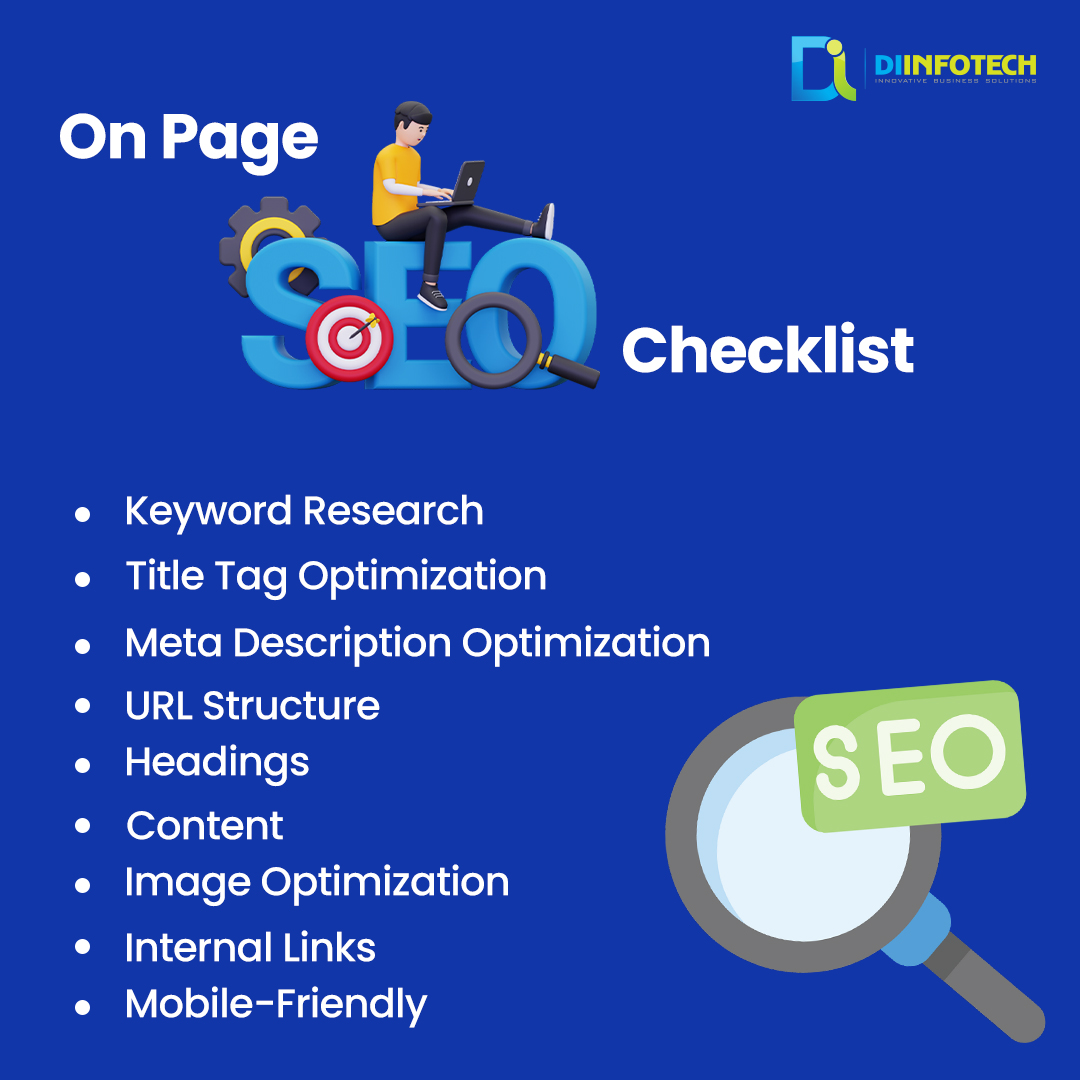
Here’s a simple checklist to follow when optimizing your web pages:
Keyword Research
Keywords are the search terms that your target audience uses on search engine results pages to find the content, product, service, or something they are looking for, as well as content that is similar to yours. Finding out the right keyword is an important thing for on-page optimization.
Consider these things when choosing keywords.
Keywords search volume: The estimate monthly searches of keyword
Keyword Difficulty: Check the difficulty of the keyword and how hard it is to get ranked.
Search intent: Check the search intent for what things users are finding out after searching keywords such as “information,” “navigational,” “commercial,” and “transactional.”
Title Tag
Title tags are the HTML tags that appear at the SERP and indicate to search engines and users what your page is about. While sometimes Google chooses by their own titles to show in search results.
How to optimize the title:
- Use primary keyword near the beginning of the title
- Write a descriptive title that indicates what your content is about.
- Try to keep your title length at 55 to 60 characters to avoid getting cut off in search results.
Meta Description
Use a descriptive meta description while using secondary keywords naturally that make it engaging so that users will get interested.
URL Structure
Keep URLs clean, short, and keyword-friendly. Which is easy to read for users
Headings Tags Optimization
Structure your content with proper heading tags (H1, H2, H3, etc.) in the content, such as H1 in the main heading along with the primary keyword, and use secondary keywords naturally in the H2 and H3.
Content Optimization
Write informative, high-quality content that naturally integrates keywords. By focusing on user intent, not writing content for search engines.
Image Optimization
Include descriptive alt text and compress images. Images could be relevant to your content and make your content more engaging by visualization.
Internal Links
Strategically, internal linking can make your content more helpful for users that can navigate from one page to other relevant pages easily through the internal linking. It is also valuable for SEO; make sure the links are relevant to the content.
Mobile-Friendly
Make sure that your page is responsive for various screen sizes such as smartphones, tablets, and desktops. Also make sure that the page is optimized for loading speed; it helps in reducing bounce rate.
Conclusion
On-page SEO is an important part of a successful SEO strategy. By understanding and implementing the important points discussed above, you can improve your website’s visibility and rankings on search engines. Whether you’re working with an SEO agency in Delhi or handling SEO in-house, following this guide will help you optimize your website for both users and search engines.
By consistently applying on-page SEO best practices, you can improve your website’s overall performance and drive more traffic to your site. Always remember to monitor your progress and make adjustments as needed to stay ahead of the competition.
FAQs
1. What is the difference between on-page SEO and off-page SEO?
On-page SEO refers to the optimization techniques that are applied directly on your website, such as content optimization, title tags, and URL structure. Off-page SEO, on the other hand, involves strategies done outside of your website, like link building and social media engagement.
2. How long does it take to see results from on-page SEO?
While results can vary, you may start to see improvements within 3 to 6 months, depending on the competitiveness of your keywords and the quality of your content.
3. Can I do on-page SEO myself?
Yes! With the right tools and knowledge, you can handle your website’s on-page SEO yourself. However, if you’re unsure, hiring an SEO agency in Delhi might help accelerate the process.
4. How often should I update my on-page SEO?
SEO is an ongoing process. It’s important to update your on-page SEO regularly, especially when there are changes in algorithms or when new keywords emerge.
5. What are some tools I can use for on-page SEO?
Some popular tools include Google Search Console, Yoast SEO, SEMrush, and Moz. These tools can help you track and optimize your on-page SEO efforts.
Also Read:
What is Local SEO: A Complete Guide for Beginners

0 Comments